
MDR vs SIEM: Detection Alone vs Action in Real Time

By N-able
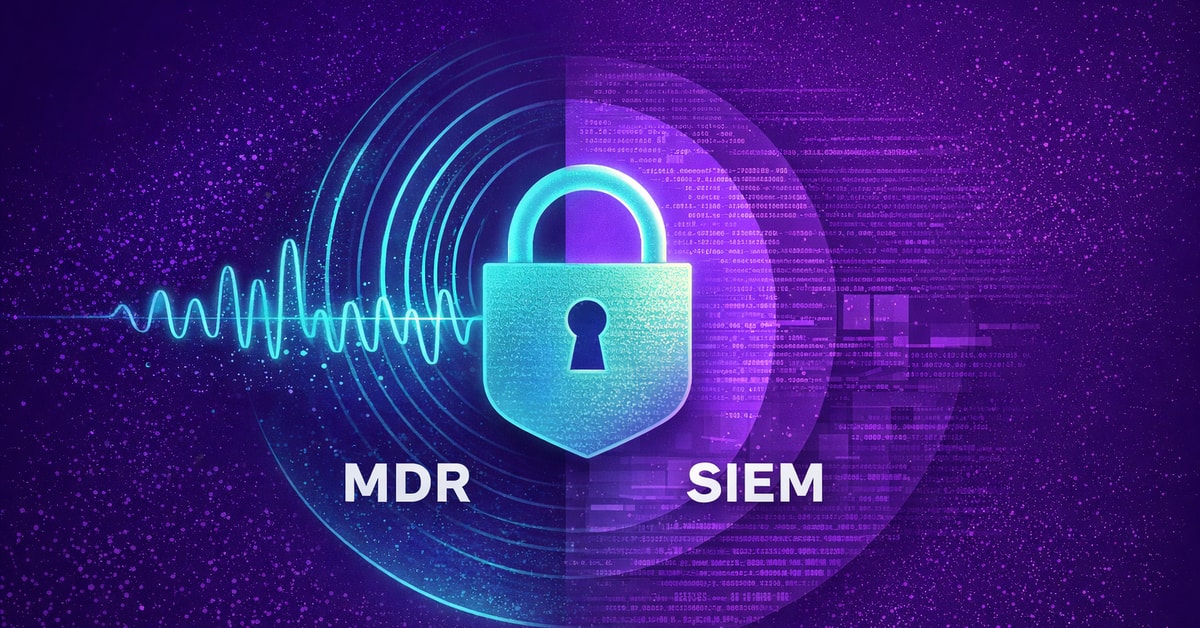
Here’s a scenario that plays out more often than it should: a ransomware payload detonates in a client environment at 4 a.m. The Security Information and Event Management (SIEM) platform flags the anomaly within minutes, but without 24/7 monitoring and expert response, alerts generate awareness, not action. By the time the internal team investigates during business hours, lateral movement has already reached the domain controller.
The question behind Managed Detection and Response (MDR) vs SIEM boils down to one thing: do we need better detection, or do we need someone to act on what’s detected? For MSPs managing security across dozens of client environments and mid-market IT teams running lean, the answer shapes everything from margins to incident outcomes.
Here’s where each delivers value, what the combination looks like in practice, and how MSPs and mid-market IT teams are deploying both.
SIEM: Detection Without a Safety Net
SIEM platforms collect, normalize, and correlate security data across an environment. Firewalls, endpoints, authentication systems, cloud services, and business applications all feed into a centralized repository. For organizations with Health Insurance Portability and Accountability Act (HIPAA), Payment Card Industry Data Security Standard (PCI DSS), or Service Organization Control 2 (SOC 2) obligations, SIEM’s logging and retention capabilities are often non-negotiable.
Here’s the thing: SIEM identifies threats. It does not stop them. The play here is understanding that dividing line. SIEM is built to ingest and retain telemetry; response requires playbooks, automation, and people who can take action fast.
The operational burden compounds quickly. Cost consistently ranks as a top SIEM challenge once log volume, retention, and staffing get factored in. For MSPs and mid-market IT teams, the staffing math alone makes SIEM-only approaches difficult because 24/7 coverage demands headcount that most budgets can’t support.
The result is alert fatigue. Defender teams routinely get buried in high-volume signal and repetitive, low-value triage work. This means SIEM value gets capped unless you layer active response on top.
MDR: Action in Real Time
MDR flips the model. Instead of handing a team a pile of alerts to sort through, MDR services combine automated detection with human-driven investigation and active response, all delivered as a managed service.
What this looks like in practice: MDR services investigate suspicious identity behavior, endpoint activity, and lateral movement attempts immediately. Routine containment actions, like isolating a host or disabling a compromised account, happen in minutes instead of waiting for the next business day.
For MSPs and mid-market IT teams that can’t justify a full Security Operations Center (SOC), MDR changes the economics entirely. The financial case holds up: organizations deploying AI extensively across prevention workflows averaged $2.2 million less in breach costs compared to those without it (IBM 2024).
Where Each Excels
SIEM and MDR solve different problems, and day-to-day outcomes depend on matching each tool to the right gap.
| Capability | SIEM | MDR |
| Centralized log aggregation | Yes | Limited |
| Long-term data retention (1 to 7+ years) | Yes | Typically shorter retention unless paired with SIEM |
| Compliance audit trails and reporting | Strong | Often requires SIEM integration |
| Historical forensic analysis | Yes | Typically relies on SIEM data |
| 24/7 threat monitoring | Requires internal staffing | Included |
| Active incident response | No | Yes |
| Proactive threat hunting | No (without dedicated analysts) | Yes |
| Alert triage and false positive filtering | Mostly manual | Included |
| Time to operational value | Often longer due to tuning and staffing | Typically faster because it’s delivered as a service |
| Automated remediation | No (without SOAR integration) | Most MDR are limited to containment |
Here’s why this matters: SIEM works as the system of record for logs, retention, and audits, while MDR acts as the « we saw it and stopped it » layer. The right mix depends on four things: compliance obligations, staffing capacity, budget structure, and how many environments you manage. Those factors play out differently depending on whether you’re an MSP or a corporate IT team.
How to Choose: MDR, SIEM, or Both
The decision isn’t really about which tool is better. It’s about which gaps are most exposed right now and what resources exist to close them. Four criteria tend to drive the answer.
Compliance requirements determine the floor. Organizations with HIPAA, PCI DSS, SOC 2, or other regulatory obligations requiring one-plus years of log retention need SIEM regardless of what else they deploy. Frameworks like the National Institute of Standards and Technology (NIST) Cybersecurity Framework expect both continuous monitoring and documented incident response, which means SIEM alone only covers half the requirement.
Staffing capacity determines what’s realistic. Effective 24/7 SIEM coverage requires multiple full-time security professionals across analyst, engineering, and incident response roles. The cybersecurity workforce gap sits at 4.8 million globally (ISC2 2024), and most mid-market and MSP budgets can’t absorb that headcount. MDR fills the gap by delivering expert monitoring and response as a service.
Budget structure shapes the business case. MDR converts what would be a six-figure fixed cost into a predictable monthly expense. For mid-market IT directors reporting to a CFO scrutinizing every line item, that cost reduction often separates a defensible business case from a rejected budget request.
Multi-tenant complexity determines scale. This is where MSPs and corporate IT teams diverge.
For MSPs
Security services represent one of the clearest margin opportunities in the MSP business. MSPs consistently see higher gross margins on managed security (like Endpoint Detection and Response, or EDR, and MDR) than on traditional antivirus. Realizing those margins depends on how the service gets delivered.
Standing up an internal SOC rarely pencils out at MSP margins, which is why so many end up partnering for MDR instead. The upshot: MDR converts fixed SOC costs into variable per-client fees while delivering consistent security outcomes across the client base.
Managing SIEM across dozens of client environments multiplies configuration, tuning, and maintenance work. Adlumin MDR/XDR was built for this model, with multi-tenant architecture and unified workflows with N-able N-central for endpoint management. That connection ties detection and response to the same platform that patches systems, hardens endpoints, and supports vulnerability management.
For Mid-Market IT Teams
Mid-market IT directors face the same constraint from a different angle. A five-person IT team supporting 1,500 employees can’t staff 24/7 security monitoring on its own. MDR cuts the cost and complexity of continuous monitoring and response, while SIEM handles the logging, correlation, and audit trail side. This means mid-market teams can meet both requirements without dedicated security headcount by combining SIEM and MDR.
That combination is what Adlumin delivers: SIEM, Security Orchestration, Automation, and Response (SOAR), and MDR in a single platform, with a 24/7 SOC and automated containment for common threats.
Why the Answer Is Usually Both
Both MSPs and mid-market IT teams arrive at the same conclusion from different directions: detection without response is a half-measure, and response without log retention creates compliance gaps. SIEM without response capability leaves every alert as a task for an already overloaded team. MDR without SIEM can limit forensic investigation depth and leave audit trails incomplete.
The N-able approach to this lifecycle connects Adlumin’s detection and response capabilities with N-central for pre-attack hardening (patching, EDR, and DNS Filtering) and Cove Data Protection for post-attack recovery. That architecture covers the before, during, and after sequence from a single platform. Both MSPs and corporate IT teams get enterprise-grade security outcomes without enterprise-level staffing.
The upshot: business-hours-only security is a timing bet, and attackers don’t keep office hours. Ransomware appeared in 44% of confirmed breaches last year, and SMBs took the hardest hit (Verizon DBIR 2025). Closing the most immediate risk gap matters more than picking one tool over the other, and often that means deploying both strategically.
Frequently Asked Questions
What is the main difference between SIEM and MDR?
SIEM collects, normalizes, and correlates security log data for threat detection and compliance reporting. MDR adds 24/7 human monitoring, active threat hunting, and executed incident response, including containment actions like endpoint isolation and account lockdown.
Can MDR replace SIEM entirely?
Not for most organizations. MDR excels at active threat monitoring and incident response but typically doesn’t replace SIEM’s centralized log aggregation, long-term retention (often one to seven-plus years for regulated environments), and audit-trail reporting.
How long does it take to deploy MDR compared to SIEM?
MDR generally reaches value faster because the tooling, monitoring, and response processes come packaged as a service. SIEM deployments often take longer because log ingestion, parsing, correlation rules, use-case tuning, and staffing have to be built and maintained internally.
What does Adlumin MDR/XDR include that standalone SIEM does not?
Adlumin MDR/XDR combines SIEM and SOAR so they work together out of the box, then backs that stack with a 24/7 SOC that hunts threats, filters false positives, and executes incident response actions that standalone SIEM can’t deliver by itself.
How many security staff are needed to run SIEM effectively?
Running SIEM effectively requires ongoing engineering, content tuning, alert triage, threat hunting, and incident response coverage well beyond just owning the tool. For 24/7 operations, most teams need multiple analysts plus engineering and IR roles for shift rotation, which is why many mid-market IT teams and MSPs pair SIEM with MDR instead of staffing it all internally.
© N‑able Solutions ULC and N‑able Technologies Ltd. All rights reserved.
This document is provided for informational purposes only and should not be relied upon as legal advice. N‑able makes no warranty, express or implied, or assumes any legal liability or responsibility for the accuracy, completeness, or usefulness of any information contained herein.
The N-ABLE, N-CENTRAL, and other N‑able trademarks and logos are the exclusive property of N‑able Solutions ULC and N‑able Technologies Ltd. and may be common law marks, are registered, or are pending registration with the U.S. Patent and Trademark Office and with other countries. All other trademarks mentioned herein are used for identification purposes only and are trademarks (and may be registered trademarks) of their respective companies.