
The third-party patch gap: why your riskiest surface isn’t the OS

By Oliver Bengtsson
Ask most IT teams where they spend their patching effort, and the answer is the operating system. Windows updates, macOS releases, Linux kernels. But that’s not where attackers land. The third-party applications sitting on top of your OS, the browsers, PDF readers, and runtimes on every endpoint, are the number one exploited surface in your environment. And for most teams, they’re systematically under-managed.
That gap is where real risk lives. Here’s why third-party applications matter more than your OS, why the problem is getting harder to manage, and how N-central™ and N-sight™ close the gap without adding a single tool.
The reality: third-party apps are where attackers land
Operating system patching gets the attention. Third-party applications get exploited.
The vast majority of endpoint breaches start with an unpatched third-party application: a browser, a PDF reader, a communication tool, a developer utility, or one of the dozens of business apps running across your estate. These apps make up the largest, fastest-changing, and most-exploited surface in any modern environment.
Attackers know this. They monitor vendor disclosures and weaponize the most widely deployed apps first, the same browsers, PDF readers, and runtimes that exist on every machine you manage. The disclosure-to-exploitation window is now measured in hours, not days.
And because tracking vendor advisories across hundreds of apps by hand is impossible at lean-team scale, most teams default to patching what’s loud: the apps that generate tickets or make headlines. Everything else stays exposed, quietly.
So why do so many tools treat third-party patching as an afterthought? Because most patch tools are built OS-first. Third-party support gets bolted on later, with a narrow catalog and inconsistent coverage. The result is a strategy that defends the surface attackers mostly ignore and leaves the surface they target exposed.
Any vulnerability and patch strategy that doesn’t treat third-party applications as high priority is solving last decade’s problem.
Why the problem is worse now
Third-party coverage was always tricky. Today, four factors make it harder than ever.
Fragmented tools per OS
A typical IT team runs one tool for Windows patches, another for macOS, a third for Linux, and a fourth, or none, for third-party apps. Each tool has its own catalog, its own cadence, and its own blind spots. Apps that fall outside every catalog become the ones attackers reach first.
Fragmentation also splits your visibility. When coverage is spread across four consoles, no one has a single, honest view of what’s actually exposed across the estate.
Inconsistent catalog update cadences
Even when a third-party app is technically « covered, » catalog updates often lag behind vendor releases. Your team may be deploying yesterday’s patch while attackers exploit today’s vulnerability. A slow catalog turns coverage into a false sense of security.
AI-driven threat acceleration
Attackers now use generative AI to scan for, identify, and exploit vulnerabilities in third-party applications in record time. This automation triggers a massive surge in both the number of active cyberthreats and the volume of patches you must deploy. When bad actors use machine learning to weaponize exploits within hours of disclosure, your team can’t afford to fall behind on third-party security.
Manual tracking that can’t scale
Tracking vendor advisories across hundreds of applications by hand is impossible at lean-team scale. There are too many apps, too many disclosures, and too few hours. The apps that fall through are rarely the loud ones, they’re the quiet, widely deployed utilities attackers count on you to miss.
Multiply fragmented tools, lagging catalogs, and manual tracking across an entire estate, and the outcome is predictable: the most-exploited surface becomes the least-managed one.
How N-central and N-sight build third-party patching in, not on
N-central and N-sight take the opposite approach. Third-party applications aren’t a bolt-on. They’re part of the same unified workflow your team already uses to manage IT operations.
Here’s what that looks like in practice.
Continuous scanning across 900+ applications. Built-in vulnerability scanning covers the full third-party surface across Windows, macOS, and Linux endpoints, not just the OS. No extra agents. No extra tools.
Integrated remediation across 340+ third-party applications. Scanning tells you what’s exposed; remediation closes it. From the vulnerability view, you identify a vulnerability, see the affected software, and deploy a patch across 340+ third-party applications for Windows, macOS, and Linux, from the same console and agent you use for monitoring and automation.
Unified multi-OS patching. Manage Windows, macOS, and Linux from one console, with shared policies, dashboards, and reporting. No OS-specific bolt-on tools to license, learn, or reconcile.
Policy-driven automation. Patch policies standardize scheduling, approvals, retries, offline handling, and reboot control across sites, OS types, and device classes. Completion rates stay high without manual chase work.
Audit-ready by default. Patch compliance reports and patch status in Asset View produce audit-grade evidence as a byproduct of normal operations.
Because it all lives in the platform your team already relies on, there’s no data mapping, no separate console, and no manual handoff between detection and remediation. The most-exploited surface gets covered where you already work.
The outcome: systematically covered, without adding tools
The goal isn’t more tools. It’s less exposure. When third-party coverage is built in, the surface attackers target most moves from systematically under-managed to systematically covered.
For your team, that means:
The real risk surface gets real coverage. You stop over-investing in the OS and start defending where attackers actually land.
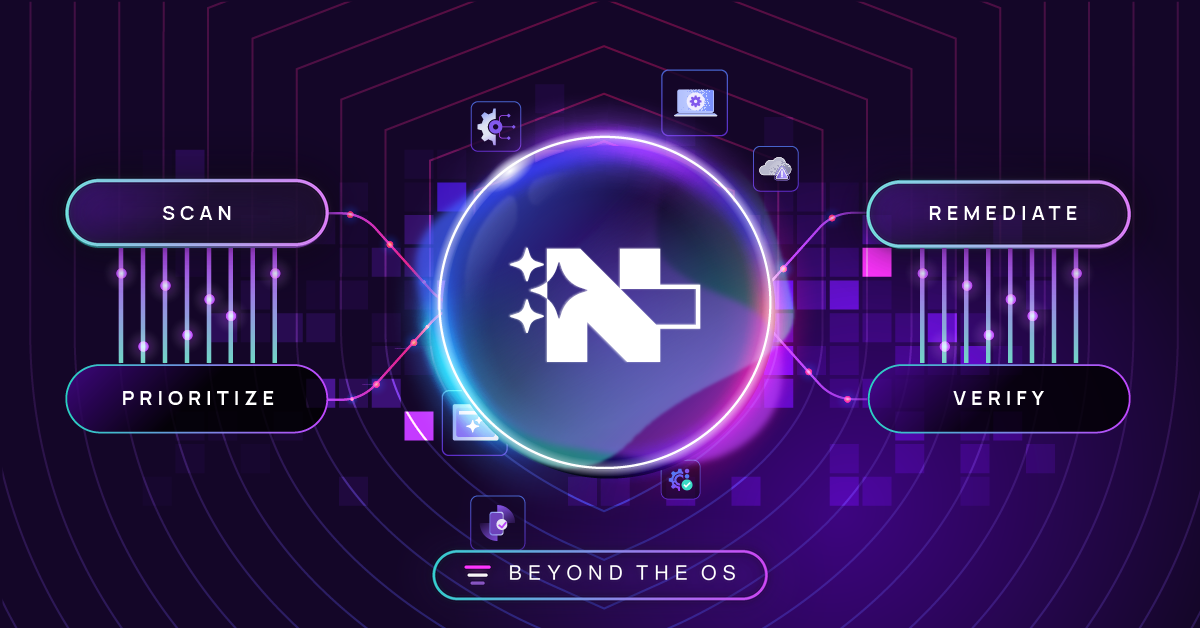
One workflow replaces four. Scanning, prioritization, and remediation for every OS and the third-party layer happen in one place, with one agent and one console.
Coverage scales past what any team could track by hand. Continuous scanning and integrated remediation replace the impossible job of chasing hundreds of vendor advisories manually.
You reduce tool sprawl. Full third-party coverage arrives inside the UEM platform you already use, at no additional cost.
Third-party applications are where attackers land first. With N-central and N-sight, they become the surface you defend best, without stitching together four tools to do it.
Ready to close the third-party patch gap? Start a free trial of N-central or N-sight, or talk to our team today to see unified vulnerability and patch management in action.
Next in this series: inside the closed loop, how scan, prioritize, remediate, and verify come together in a single continuous workflow.
© N‑able Solutions ULC and N‑able Technologies Ltd. All rights reserved.
This document is provided for informational purposes only and should not be relied upon as legal advice. N‑able makes no warranty, express or implied, or assumes any legal liability or responsibility for the accuracy, completeness, or usefulness of any information contained herein.
The N-ABLE, N-CENTRAL, and other N‑able trademarks and logos are the exclusive property of N‑able Solutions ULC and N‑able Technologies Ltd. and may be common law marks, are registered, or are pending registration with the U.S. Patent and Trademark Office and with other countries. All other trademarks mentioned herein are used for identification purposes only and are trademarks (and may be registered trademarks) of their respective companies.