
Backup for Google Workspace: How dedicated backup extends built-in retention

By N-able
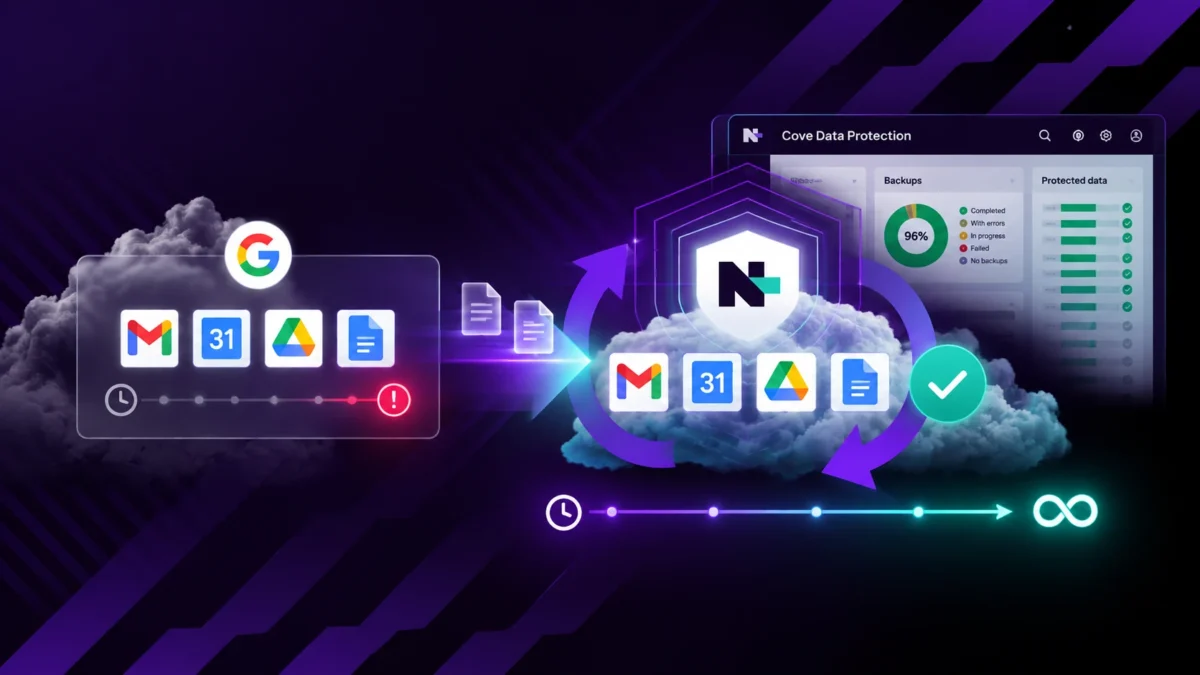
Backup for Google Workspace is assumed to be covered by the platform, but under the shared responsibility model, protecting and recovering your content is the customer’s role. This post explains what Google’s native tools protect, where recovery windows may fall short of your needs, and how to evaluate a dedicated backup solution. Read on to understand five recovery scenarios where dedicated backup adds to native tools, and what a complete Google Workspace data protection strategy looks like.
Does Google back up your Workspace data?
Google keeps Google Workspace running with high availability and offers time-boxed native recovery, which serves everyday needs well, though it works differently from dedicated backup and recovery. A common assumption is that data stored in the cloud is also backed up for long-term recovery. The platform infrastructure is engineered for uptime and resilience against hardware failures, while recovering items after the native windows have passed, such as a file deleted long ago or a mailbox from a compromised account, is a separate need that dedicated backup is designed to address.
Google Workspace includes native recovery tools. Gmail and Google Drive route deleted items to trash for a limited window, and admins can restore some deleted data within defined timeframes. Those tools are useful, and they solve everyday problems. They operate on a fixed window by design, though, and once that window passes, a longer-term recovery path becomes valuable. That distinction between platform availability and long-term data recoverability is where dedicated backup for Google Workspace adds meaningful value.
The Google Workspace shared responsibility model, explained
Under the shared responsibility model, Google is responsible for the availability and security of the Workspace platform, and you’re responsible for protecting and recovering your own data within it. This is a frequently overlooked point, and many teams discover the distinction only when they need to recover something outside the native window.
Understanding this split matters because it reframes the question. The point is that reliability and long-term recoverability are two different things, and only one of them sits on your side of the model.
What Google protects
Google protects the underlying platform: server redundancy, infrastructure uptime, and platform-level availability, plus native trash windows that let users and admins recover recently deleted items. If a Google data center has a hardware failure, that’s Google’s responsibility to solve, and it does so well behind the scenes. Deleted emails and files land in trash and stay recoverable for a defined period, giving users a safety net for quick “oops” moments. Admins have additional restore options within their own windows. These capabilities are real and valuable, and for minor, quickly noticed mistakes they do the job.
What sits on your side of the model
Long-term retention and recovery after the native windows close sit on your side of the shared responsibility model. This is a part teams often overlook. A file deleted and emptied from trash, a mailbox recycled after an employee leaves, or data encrypted by ransomware and discovered weeks later can move beyond the timeframe native tools are designed for. Native windows are measured in days and weeks, and they’re built for fast recovery of recent items. If you need to restore a specific version of a document from six months ago, or produce a departed user’s mailbox for an audit, a dedicated backup can provide that capability.
5 recovery scenarios where dedicated backup extends your reach
Here are five recovery scenarios where native Google Workspace tools provide an initial safety net, and where dedicated backup extends your recovery reach over time. Each one maps to a situation MSPs and IT teams see regularly. The pattern is consistent: native tools handle the fast, obvious cases, and dedicated backup covers the delayed, complex, or high-stakes ones.
Accidental or malicious deletion
Accidental or malicious deletion is recoverable through native trash for a limited window, and dedicated backup extends that recovery path once the window closes or trash is emptied. A user who deletes a file and notices the next day is fine. A user who deletes a folder, empties trash to free up space, and realizes the mistake months later is in a harder position. Malicious deletion by a departing employee often falls outside the quick-recovery window, since the intent is to make the data hard to retrieve. Dedicated backup with longer retention gives you a restore path that doesn’t depend on catching the problem within days.
Insider threats and employee offboarding
Insider threats and offboarding create a specific timing consideration: once a Google Workspace user account is deleted, admins have roughly 20 days to recover it. That’s a tight clock for any organization, and an especially important one for regulated or audit-sensitive environments. Reclaiming a license and deleting a departed user’s account is routine housekeeping, and it’s easy to do before anyone realizes that mailbox or Drive content might be needed months later. Automated cloud-to-cloud backup addresses this by archiving departed users’ data so it stays recoverable well past that window, letting you free up the seat without losing the historical record.
Ransomware and account compromise
Ransomware and account compromise can go unnoticed for some time, and recovery may be needed after the native windows have passed . Backups have become a direct target for attackers. A 2024 Sophos study on the impact of compromised backups found that 94% of organizations hit by ransomware reported attempts to compromise their backups. Organizations whose backups were compromised faced median recovery costs of $3M, eight times higher than those whose backups stayed intact. When an attacker has time to work quietly inside a compromised account, native trash and short windows may not leave you a clean point to restore from. This is why dedicated backup should be immutable and isolated, so an attack on production can’t reach your recovery copies. For a deeper look at defending the recovery layer itself, see how anomaly detection shields your last line of defense.
Retention needs and compliance requirements
Retention requirements often extend beyond the native windows, because audits, legal holds, and regulations can require data to be retrievable for years. A carrier, auditor, or regulator asking for a deleted user’s mailbox or a historical version of a record months later is a scenario that reaches beyond what native trash windows are built to serve. For organizations serving regulated or audit-sensitive customers, that gap between the native window and a multi-year requirement is worth planning for. With retention of multiple years, a dedicated backup gives you a recovery path that stays available long after the native windows have passed.
Lost folder structures and permissions
Lost folder structures and permissions are difficult to reconstruct manually, and restoring the surrounding structure saves effort compared with recovering individual items. Restoring a single file is one thing. Rebuilding shared Drive hierarchies, folder relationships, and the metadata that makes content usable is another. When structure is lost, a pile of recovered files without their original organization can create days of manual cleanup. Granular backup and restore that preserves folders and organization lets you put data back the way it was, not just retrieve the raw contents.
Where Google Vault and Google Takeout help, and where dedicated backup complements them
Google Vault and Google Takeout are valuable for their intended purposes, while dedicated backup complements them by automatically backing up and restoring data. It’s worth being precise here, because both tools are sometimes expected to serve as backup, which isn’t what they were designed for.
Google Vault is built for archiving, eDiscovery, and legal hold. It helps organizations retain and search data for litigation and compliance purposes, and it does that job well. It isn’t designed to restore a folder, a mailbox, or a Drive to a specific earlier state as an operational recovery workflow. Google Takeout, meanwhile, is a manual export utility. It lets users or admins download copies of data, serving as a manual, point-in-time export rather than an automated, restorable backup system. Relying on Takeout for data protection means someone has to remember to run it, store the exports safely, and manually reconstruct data during a crisis.
Dedicated backup for Google Workspace complements these tools by automating the capture of your data on a regular cadence, retaining it long-term, and restoring it granularly back into Workspace on your timeline. That combination, automated, retained, and restorable, is what rounds out a complete data protection strategy alongside Vault and Takeout.
What a dedicated backup for Google Workspace should do
A dedicated backup for Google Workspace should capture your data automatically, retain it well beyond native windows, restore it granularly, and protect the backups themselves from tampering. Use this checklist to evaluate any Gmail backup for business or Google Drive backup solution you’re considering:
- Automated cloud-to-cloud backup of Gmail, personal Drive, shared drive content, Contacts, and Calendar on a frequent cadence, so protection doesn’t depend on someone remembering to run an export.
- Long-term retention, up to seven years, that extends well beyond Google’s roughly 20-day deleted-account recovery window.
- Deleted-user protection that automatically archives departed or unlicensed users, so historical data stays recoverable even after the seat stops billing.
- Encrypted, immutable backups with AES-256 encryption in transit and at rest, plus immutable copies that resist tampering and ransomware.
- Included cloud storage with no per-GB quotas or throttling, so costs stay predictable as mailboxes and Drive usage grow.
- A unified dashboard that shows Google Workspace status alongside your other workloads, so there’s no second console to manage.
How N-able approaches data protection for Google Workspace
N-able approaches Google Workspace data protection with the same cloud-native philosophy that powers Cove Data Protection across servers, workstations, and Microsoft 365: immutable and isolated backups and a unified multi-tenant dashboard. Cove Data Protection™ for Google Workspace™ is built to make SaaS backup something that just works, without a second vendor, a second bill, or a second restore workflow to learn.
That philosophy shows up in the details. Cove Backup for Google Workspace is cloud-native by design, sent direct-to-cloud with AES-256 encryption and immutable copies that keep an attack on production from reaching your recovery data. TrueDelta technology moves up to 60x less data than image-based tools, so frequent backups stay practical without straining bandwidth or budgets. Automated recovery testing, which posts an over 99% success rate, confirms that your backups will actually restore when you need them, replacing hope with verified proof. And everything lives in one console, the same place teams already manage Microsoft 365 backup and flexible disaster recovery.
For MSPs and IT teams running mixed environments, this brings Google Workspace protection into the same platform, with predictable per-user pricing and cloud storage included, so you can standardize your entire backup strategy on one solution.
Ready to extend your Google Workspace recovery strategy?
If your data protection strategy for Google Workspace still relies on native recovery and retention windows alone, now is the time to see what dedicated backup adds. Explore Cove Backup for Google Workspace and discover how immutable, cloud-native backups and unified management can help protect Gmail, Drive, Contacts, and Calendar under the same platform you already trust for the rest of your environment.
Google Workspace™, Gmail™, Google Drive™, Google Calendar™, Google Contacts™ and Google Vault™ are trademarks of Google LLC.
Microsoft 365 is a trademark of Microsoft Corporation.
The N-able trademarks, service marks, and logos are the exclusive property of N-able Solutions ULC and N-able Technologies Ltd. All other trademarks are the property of their respective owners.
© 2026 N-able Solutions ULC and N-able Technologies Ltd. All rights reserved.