
How MDR Detects Threats, Behaviors, and Blind Spots

By N-able

An EDR tool flags suspicious lateral movement, but the security team is buried under hundreds of daily alerts. By the time an analyst investigates, the attacker has already exfiltrated data and staged ransomware. The detection worked. The response didn’t.
Managed Detection and Response (MDR) solves this by wrapping detection technology, 24/7 human expertise, and automated remediation into a single service that turns alerts into outcomes. But MDR is not a black box, and not all detection is created equal.
Here’s how MDR detects threats and infrastructure blind spots, where detection still falls short, and how it all fits into a broader security lifecycle.
Understanding MDR
MDR bridges the gap between detection technology and skilled staff. EDR, Security Information and Event Management (SIEM), and Extended Detection and Response (XDR) generate alerts, but someone still needs to act on them. MDR adds the people who hunt threats, triage incidents, and drive response on your behalf.
The line between MDR and a traditional Managed Security Service Provider (MSSP) is blurred in practice. MSSPs monitor broadly and alert when something looks wrong. MDR providers investigate, contain, and respond to incidents. For teams already delivering managed IT or running lean internal security operations, MDR fills the gap without requiring a full Security Operations Center (SOC) buildout.
Core Components of MDR
Every alert that reaches an analyst has already passed through multiple detection layers. Here’s what each component handles:
- SIEM support provides centralized log aggregation and real-time correlation, collecting the raw events needed to spot patterns that single tools miss.
- XDR platforms unify analytics across endpoints, cloud, network, and identity so detections are not trapped in separate consoles.
- Threat intelligence feeds enrich detections with external context from commercial, open-source, and government sources, including Cybersecurity and Infrastructure Security Agency (CISA) Indicator of Compromise (IOC) guidance.
- Security Orchestration, Automation, and Response (SOAR) executes response playbooks automatically. High-confidence detections become containment actions without waiting for a human to click through steps.
The SOC team layers human judgment on top of the automated stack to validate findings, add context, and make response decisions.
How MDR Works
MDR follows a continuous cycle: collect, detect, investigate, respond, and refine. The workflow starts with telemetry ingestion across endpoints, cloud workloads, network traffic, and identity systems. Detection engines and threat intelligence feeds flag suspicious activity automatically, filtering noise before it reaches an analyst.
When a detection fires, SOC analysts investigate to confirm whether the alert is a true positive or benign activity. They add context: what the attacker targeted, how far they progressed, and what’s at risk. Confirmed threats trigger containment, either through automated SOAR playbooks that isolate endpoints and revoke credentials, or through analyst-driven response for complex incidents.
After containment, the SOC team works to determine the full scope of the incident and surface any additional compromises before the environment is cleared. That investigation informs detection tuning, closing the gaps attackers exploited. This feedback loop is what separates MDR from static monitoring: each incident sharpens the next detection cycle.
How MDR Detects Threats
MDR combines behavioral analytics, anomaly detection, threat intelligence, and known-bad indicators. Signature-based detection matches network traffic, file hashes, registry keys, and domain queries against databases of known malicious patterns. IOCs, the forensic artifacts that indicate a system has been compromised (National Institute of Standards and Technology NIST SP 800-53 Rev. 5, SI-4(24)), feed this matching process.
What this looks like in practice is layered detection. SIEM and XDR platforms ingest IOC feeds and automatically scan incoming telemetry for matches. The MITRE ATT&CK framework adds another dimension by mapping observed activity to known Tactics, Techniques, and Procedures (TTPs). This gives analysts a structured way to understand where an attacker sits in the attack lifecycle.
How MDR Detects Behavior
Signature matching catches known threats, but attackers increasingly use legitimate credentials and living-off-the-land techniques that do not match any known signature. Behavioral detection covers what signatures miss by identifying deviations from normal activity patterns. This exposes previously unknown threats that signature databases can’t match.
User and Entity Behavior Analytics (UEBA) sits at the center of behavioral detection. UEBA collects data from authentication logs, file systems, cloud applications, and network traffic, then applies machine learning to establish a baseline of normal behavior. It watches for deviations across a few common dimensions:
- Authentication anomalies: Impossible travel, atypical login times, unfamiliar devices, and new geographies, especially when these signals cluster together across multiple log sources.
- Privilege anomalies: Unusual admin role assignments, permission changes, and rare privileged actions that do not fit the user’s history. This catches privilege escalation through “legitimate” tooling.
- Data access anomalies: Abnormal download volume, atypical SharePoint/OneDrive access patterns, and mass file reads that look like collection or exfiltration.
- Network and service anomalies: New outbound destinations, unusual protocols, and abnormal service-to-service calls that indicate command-and-control or lateral movement.
Pairing behavioral detection with SIEM correlation and XDR analytics surfaces threats that evade signature-based tools, but analysts still need to validate context and decide the right response.
That said, behavioral detection has its own limits. Credential misuse remains one of the hardest attack types to detect, particularly in cloud environments where behavioral baselines are harder to establish. Credential abuse ranked among the top initial access vectors in confirmed breaches (Verizon DBIR 2025).
How MDR Detects Blind Spots
Beyond active threats, MDR uncovers hidden risks across infrastructure that other tools miss. Blind spots aren’t just unmonitored devices—they’re the gaps between security controls where attackers move laterally without triggering a single alert: identity systems with over-provisioned access, cloud workloads generating anomalous traffic, or user accounts behaving outside their normal patterns.
MDR identifies these gaps through continuous correlation across log sources, identity data, network traffic, and user behavior. When an account authenticates from an unrecognized location, accesses systems it’s never touched before, and transfers an unusual volume of data in the same session, no individual alert fires—but the behavioral pattern surfaces in the MDR platform. Threat hunters look for these signals deliberately during proactive sweeps rather than waiting for a threshold to trigger.
The play here is that blind spot detection turns MDR from a reactive alert-response service into an ongoing posture assessment. Misconfigurations get flagged before attackers exploit them, over-provisioned accounts get surfaced for review, and anomalous access patterns get investigated before they become incidents.
Can MDR Detect Everything?
Even with layered detection, blind spot discovery, and correlation across multiple telemetry sources, no detection system covers everything. Four limitations show up consistently across MDR deployments:
- Endpoint-only detection limits visibility. Many MDR services evolved from EDR solutions and remain limited to endpoint monitoring without extending detection across cloud, identity, and network telemetry.
- Cloud and identity environments remain undermonitored. Credential abuse continues to rank among the top initial access vectors in confirmed breaches, and gaps like missing or misconfigured MFA show up repeatedly in incident response findings.
- Supply chain risk sits outside the detection perimeter. Third-party involvement doubled year-over-year and was a factor in 30% of all breaches analyzed (Verizon DBIR 2025). Traditional MDR monitors assets under direct organizational control, while third-party vendors and externally managed SaaS applications fall outside that boundary.
- Detection logic gaps leave room for advanced threats. Many services detect the attack but miss the vulnerability or misconfiguration that allowed it.
The upshot: MDR is a critical layer, not a complete shield. Evaluating an MDR provider means understanding which of these gaps their architecture actually covers.
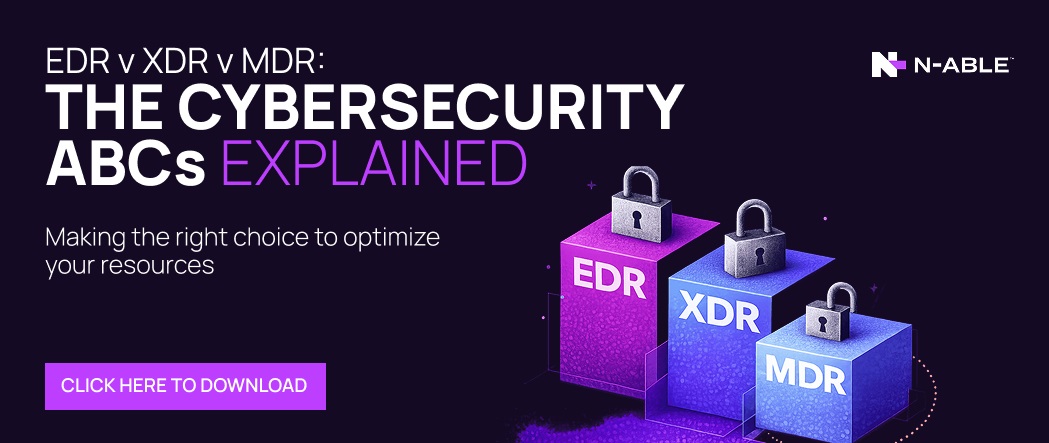
MDR vs. EDR vs. XDR
Understanding those gaps requires knowing what each detection layer actually provides, since MDR, EDR, and XDR cover different ground. These three terms overlap constantly, and the confusion is real. Here’s how they differ in scope, staffing, and response capability:
| Capability | EDR | XDR | MDR |
| Coverage | Endpoints only | Endpoints, cloud, network, identity | Varies by provider (endpoint-only to full stack) |
| Staffing | Your team operates it | Your team operates it | Vendor SOC operates it 24/7 |
| Detection | Endpoint telemetry, behavioral analysis | Correlated telemetry across multiple sources | Layered detection plus human threat hunting |
| Response | Automated endpoint actions | Cross-platform automated response | Automated plus analyst-driven remediation |
| Best for | Teams with security staff and endpoint focus | Teams managing complex multi-source environments | Teams without dedicated security analysts |
The play here is that EDR and XDR are tools, while MDR is a service that wraps around those tools. An MDR provider typically deploys EDR or XDR as the detection engine, then adds 24/7 monitoring, threat hunting, and incident response on top. The choice depends less on technology preference and more on whether your team can operate detection tools around the clock.
How Adlumin Fits Into the Detection Picture
Architecture determines which of those gaps an MDR provider actually covers. Adlumin MDR closes several of them by pairing machine learning detection with a 24/7 expert-led SOC across the full telemetry stack.
Adlumin’s UEBA capabilities build environment-specific baselines and flag anomalies without manual rule tuning. The platform’s Identity Threat Detection and Response (ITDR) targets credential-based attacks in Microsoft 365 environments, addressing the identity gap that most endpoint-only MDR providers miss. Adlumin’s SOAR engine autonomously stops threats through endpoint isolation and credential revocation, so analysts spend time on advanced threats instead of routine containment.
What this looks like in practice: Ventnor City, New Jersey deployed Adlumin MDR and saw results within six hours. The platform detected thousands of unauthorized access attempts targeting their police department’s systems, and the team isolated the compromised workstation before attackers reached the broader network (Ventnor City case study).
Bottom line: this detection and response layer fits into a broader lifecycle. Before an attack, N-able N-central hardens endpoints and manages vulnerabilities. During an attack, Adlumin Security Operations detects and stops threats through automated SOAR workflows. After an attack, Cove Data Protection recovers systems through cloud-native backup. This before-during-after coverage moves MDR from a point solution to a unified cyber-resilience strategy.
Detection Is Only as Good as What Surrounds It
Detection without rapid response only tells you what happened. Response without recovery still leaves the business exposed. Real resilience layers prevention, automated response, and rapid recovery so each one covers what the others miss.
To see how the N-able before-during-after approach applies to your environment, contact us for a conversation about your detection and resilience goals.
Frequently Asked Questions
What makes MDR different from just having EDR on every endpoint?
EDR is a detection tool that generates alerts, while MDR is a managed service that includes EDR, human analysts, threat intelligence, and active threat response. MDR investigates and responds to threats 24/7 so your team does not have to.
Can MDR detect threats in cloud environments like Microsoft 365?
It depends on the provider. Some MDR services remain endpoint-focused, so the play here is confirming that cloud telemetry, SaaS monitoring, and identity detections are actually included.
How does behavioral detection reduce false positives compared to signature-based detection?
Behavioral detection learns what normal looks like for each user and entity, flagging meaningful deviations rather than matching static rule sets. This reduces alert noise, though analyst validation is still needed to distinguish real threats from legitimate changes.
Why is supply chain risk a blind spot for most MDR services?
MDR monitors assets under direct organizational control, but third-party vendors sit outside that perimeter. Third-party involvement was a factor in nearly a third of all breaches analyzed, making external visibility a separate problem to solve alongside MDR (Verizon DBIR 2025).
How does automated remediation work within an MDR service?
Automated remediation uses predefined playbooks to isolate compromised endpoints, terminate malicious processes, and revoke credentials before an analyst needs to intervene. This cuts response time dramatically when the detection confidence is strong (NIST SP 800-61 Rev. 3).