
AI industrialized the attack. Here’s how IT teams industrialize the response.

By Oliver Bengtsson
Attackers used to work at human speed. A skilled researcher found a vulnerability, built an exploit, and chained it into an attack over days or weeks. That gave defenders room to scan, triage, and patch. That room is gone.
AI hasn’t just changed how IT teams work, it’s changed how attackers operate. Vulnerability discovery, exploit weaponization, and attack chaining that once took weeks now happen in hours. Unfortunately, the monthly patch cycles and manual triage that most teams still run were built for a slower world.
This is the final post in our series on AI-accelerated vulnerability and patch management, and it’s where every thread comes together: how AI compressed the attacker workflow, why old defender cadences can’t keep pace, and how N-central™ and N-sight™ match that speed with guided intelligence.
The shift: AI industrialized cybercrime
What used to be a slow, manual attacker workflow is now an industrialized pipeline. Threat actors use AI and open-source offensive frameworks to compress every stage of the attack lifecycle, generating, weaponizing, and packaging proof-of-concept exploits into attack chains at machine speed.
The tooling behind this shift is no longer difficult to obtain:
- AI-assisted exploit generation turns a fresh disclosure into working code fast.
- Mythic-style command-and-control platforms give attackers flexible, automated post-exploitation.
- Automated reconnaissance maps targets at scale without human effort.
- LLM-powered phishing produces convincing lures in seconds, at volume.
Three consequences define the new reality:
Disclosure-to-exploitation windows have collapsed. The gap between a CVE going public and exploitation in the wild is now measured in hours, and in some cases exploitation comes first.
Lower-severity CVEs are being chained. Attackers bundle medium-severity vulnerabilities into higher-impact attack chains. A vulnerability you’d have deprioritized last year may now be the first step in a critical breach.
The skill barrier has dropped. AI assistants let less-skilled attackers operate like senior threat researchers. It’s not just the sophisticated ones getting faster, it’s the number of capable adversaries growing.
Why old defender cadences can’t keep up
In brief, the world has changed, and most defender workflows were designed for a threat environment that no longer exists.
Monthly patch cycles, weekly vulnerability scans, and manual triage all made sense when exploitation took weeks. Against an industrialized attacker, that same rhythm becomes a liability:
- Monthly patch cycles leave vulnerabilities open for weeks while attackers weaponize them in hours.
- Weekly scans create blind spots between cycles, exactly where a fresh CVE lands.
- Manual triage asks technicians to cross-reference severity, exploitation status, and device exposure by hand, one CVE at a time.
The math is simple. When the threat moves in hours and your response moves in weeks, the gap belongs to the attacker. Speed of response is no longer a competitive edge. It’s table stakes.
How N-central and N-sight industrialize the response
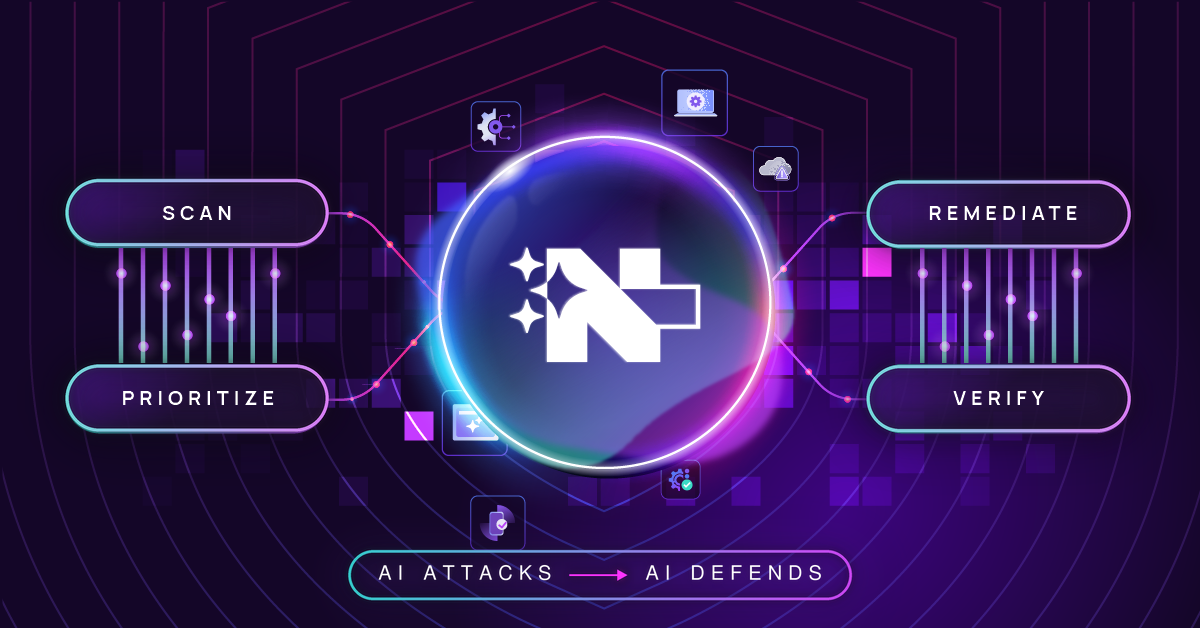
If AI compressed the attacker workflow, the answer is to compress yours. N-central and N-sight connect detection, prioritization, remediation, and verification in one continuous, AI-accelerated workflow inside the UEM platform your team already uses.
Detect and verify continuously
Built-in vulnerability scanning runs every 6 hours across 900+ applications on Windows, macOS, and Linux endpoints, with no extra agents or tools. When a new CVE lands, you trigger an on-demand scan immediately rather than waiting for the next cycle, and the same on-demand re-scan verifies the fix landed. You close the loop with evidence, not assumptions. That’s the closed loop we detailed in part four: scan, prioritize, remediate, verify.
Prioritize with N-zo Vulnerability Expert
Speed without focus just means fixing the wrong things faster. The N-zo Vulnerability Expert™ combines CVSS severity, CISA KEV active exploitation status, EPSS exploit probability, and live device context to surface the exposures that carry the highest real-world risk. Ask it “which vulnerabilities should I address first today?” and get a ranked, plain-language answer in seconds. When attackers chain medium-severity vulnerabilities, that’s the exploitation and probability context a static score can’t give you.
Remediate and resolve with N-zo Patch Expert
Once you know what matters, you fix it without leaving the vulnerability view. Scanning covers 900+ applications; remediation closes the loop across 340+ third-party applications, from the same console and agent you use for monitoring and automation. When a patch fails, the N-zo Patch Expert™ explains why in plain language and whether it’s safe to redeploy, without trawling logs or vendor advisories. That’s the failed-patch triage from part two and the built-in third-party coverage from part three, working together on the surface attackers target most.
One prompt, full context, clear next step
The through-line across this series is guided intelligence. N-zo turns senior-level security analysis into a single conversational prompt, so every technician acts with confidence. Your team stops assembling context by hand and starts closing risks, without adding headcount.
The outcome: move at the pace the threat now demands
The teams that survive this shift compress their own workflows to match the attacker. Detect, prioritize, remediate, and verify in minutes, not days. Anything slower is exposure.
Across this series we’ve built the case one piece at a time. This is where it comes together.
AI industrialized the attack. We industrialized the response.
Ready to close the gap between disclosure and remediation? Start a free trial of N-central or N-sight, or talk to our team today to see AI-accelerated vulnerability and patch management in action.
This concludes our five-part series on AI-accelerated vulnerability and patch management. Start from part one to see how the full closed loop comes together.
© N‑able Solutions ULC e N‑able Technologies Ltd. Todos os direitos reservados.
Este documento é fornecido apenas para fins informativos e não deve servir de base para aconselhamento jurídico. A N‑able não oferece nenhuma garantia, expressa ou implícita, nem assume qualquer responsabilidade legal ou responsabilidade pela precisão, integralidade ou utilidade de qualquer informação nele contido.
As marcas N-ABLE, N-CENTRAL e outras marcas registradas e logotipos N‑able são de propriedade exclusiva da N‑able Solutions ULC e da N‑able Technologies Ltd e podem ser marcas legais comuns, registradas ou de registro pendente com o Escritório de Marcas e Patentes dos EUA e com outros países. Todas as outras marcas comerciais mencionadas neste documento são usadas apenas para fins de identificação e são marcas comerciais (e poderão ser marcas registradas) de suas respectivas empresas.