

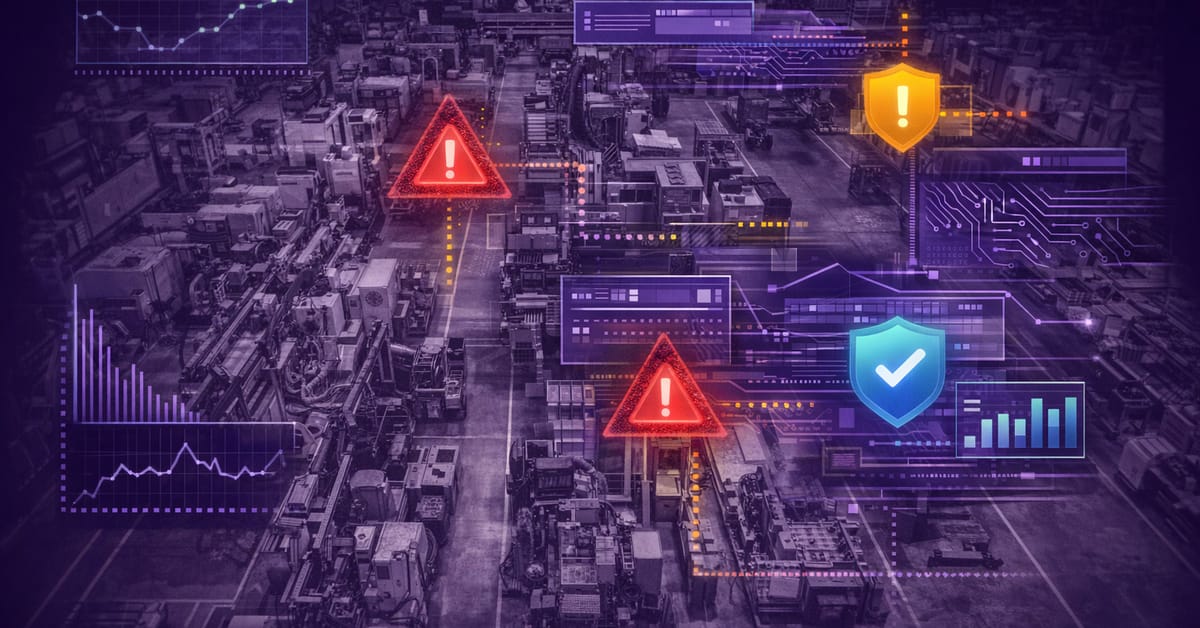
Ransomware variants now target programmable logic controllers and backup systems before encrypting production data, and many manufacturing environments lack the monitoring depth to catch lateral movement before a line goes down. That gap between what attackers do and what lean security teams can see is where manufacturing risk lives.
Managed Detection and Response (MDR) closes that gap with continuous monitoring, active threat detection, and analyst-led incident response built for environments where uptime is non-negotiable and patching mid-shift is not an option.
This guide covers the MDR services that matter most in operational technology (OT) environments, why supply chain exposure keeps rising, how layered protection works across prevention, detection, and recovery, and where N-able fits across all three phases.
Key benefits of MDR for manufacturing
MDR delivers the detection depth, response speed, and compliance documentation that manufacturing environments require but lean IT teams rarely have the headcount to build.
Faster detection and 24/7 coverage
Dwell time drops and exposure shrinks. Ransomware can linger in OT environments before detection, giving attackers more time to move through plant networks. MDR services with around-the-clock monitoring compress that detection window. Potential shutdowns become contained incidents.
Compressing that window requires analysts on duty at all hours, and that is where the staffing reality hits. The cybersecurity workforce gap stands at 4 million globally (ISC2 2024), and manufacturing competes with every other industry for the same talent pool. For a mid-market manufacturer with a small IT team, building 24/7 SOC coverage internally is not realistic. MDR provides analysts watching the environment at all hours, filling a role most manufacturing companies cannot hire for. Detection speed and staffing are only part of the equation, though. How that response actually plays out on a production floor matters just as much.
Response and governance that fit production reality
MDR keeps production uptime intact during incidents. Standard IT incident response playbooks often call for isolating compromised systems immediately. On a manufacturing floor, that isolation could halt a production line. MDR services built for these environments account for safety considerations and operational impact before taking containment actions. That reduces the chance that a response step shuts down something it was trying to protect.
Response capabilities also feed directly into compliance. Frameworks like Cybersecurity Maturity Model Certification (CMMC) and IEC 62443 all require continuous monitoring, incident handling, and documented response workflows. MDR supports these control requirements and creates auditable security processes. Those same audit trails strengthen cyber insurance conversations, because underwriters increasingly evaluate detection and response capabilities when assessing risk.
The upshot: manufacturers do not just need more alerts. They need coverage, response, and documentation that work within production constraints.
Common MDR services for manufacturing
Manufacturing MDR goes beyond standard IT threat detection. OT endpoints like programmable logic controllers (PLCs) and human-machine interfaces (HMIs) cannot accept traditional security agents, cannot be rebooted during production shifts, and can crash from active scanning. Every service component must work around those constraints.
Visibility and monitoring across IT and OT
The play here is coverage that respects plant floor constraints while still giving teams enough visibility to detect and respond to real threats.
- Hybrid Endpoint Detection and Response (EDR): Agent-based EDR covers Windows-based HMIs and engineering workstations, while passive network-based behavioral monitoring protects PLCs and embedded controllers that cannot accept agents. This hybrid approach creates visibility across systems that have very different operational limits.
- Industrial network monitoring: Standard network detection tools treat manufacturing protocols like Modbus, EtherNet/IP, and PROFINET as opaque traffic. OT-aware monitoring parses these protocols to catch anomalies without disrupting operations.
- OT-specific threat hunting: Most Industrial Control System (ICS) and OT organizations deploy detection tools, but far fewer have trained staff conducting threat hunting. MDR fills that gap with analysts who understand industrial threat intelligence and the MITRE ATT&CK for ICS framework.
- OT-informed incident response: Containment decisions on the plant floor require coordination with safety officers and pre-authorized production impact thresholds. MDR incident response playbooks account for manual fallback procedures and the reality that some systems cannot be isolated mid-shift.
- ICS vulnerability management: Teams must steadily review and prioritize Cybersecurity and Infrastructure Security Agency (CISA) ICS advisories. MDR services triage these advisories against a client’s actual OT asset inventory and recommend compensating controls when patching is not feasible.
Each service addresses constraints generic IT security tools were never designed to handle. The result is visibility across the full IT and OT environment where most manufacturing blind spots live. That visibility also explains why supply chain risk keeps moving to the center of the conversation.
Why supply chain security is so critical in 2026
Supply chain attacks remain a major concern for manufacturing, and many organizations still feel unprepared. Here’s the thing: manufacturing supply chains create a dangerous attack surface because IT compromises at a supplier can propagate directly into OT environments.
Supplier access and software dependencies expand exposure
Every external connection into a manufacturing network is a potential attack path. A compromised vendor VPN credential or an infected enterprise resource planning (ERP) update can expose data and reach production systems. The average global cost of a data breach reached $4.4 million in 2025 (IBM 2025), and manufacturing’s interconnected supplier relationships multiply those entry points. That financial exposure is compounding as regulators begin enforcing stricter reporting requirements.
Regulatory deadlines raise the stakes
Regulatory pressure adds urgency on top of the operational risk.
- CMMC Phase 1 has been active since November 2025 for defense supply chain entities
- NIST SP 800-171 compliance requirements continue tightening for any manufacturer handling Controlled Unclassified Information (CUI).
- For publicly traded manufacturers, the SEC’s cybersecurity disclosure rule requires reporting material cyber incidents within four business days of determining materiality.
These deadlines carry contract and revenue implications. Third-party access controls, vendor credential management, and network segmentation become recurring priorities for every team managing manufacturing environments.
How to protect manufacturing from cyber-threats
Protection in manufacturing environments works differently than in a corporate office. OT systems generally prioritize availability and integrity over confidentiality, and security controls must respect that hierarchy. What this looks like in practice is a layered approach built around production environment limitations.
Core protections that reduce operational risk
Each control here has to reduce cyber risk without creating production risk. MDR ties these controls together by monitoring them in real time and responding when any layer fails.
Every protection strategy starts with knowing what is on the network. Passive discovery in OT can catalog assets such as communication protocols and, in some cases, firmware versions and vendor support status, but OT guidance does not require asset discovery to rely exclusively on passive methods. MDR uses that asset inventory as a detection baseline. New or unauthorized devices get flagged the moment they appear.
Once assets are visible, the next step is controlling how they communicate. Segmentation limits blast radius by applying the ISA/IEC 62443 zones and conduits model, which groups systems by security requirements and controls communication paths between them. Effective implementations deny all connections to OT networks by default unless explicitly allowed by IP address and port. MDR monitors conduit boundaries for anomalous cross-zone traffic. That catches lateral movement that segmentation alone cannot prevent.
Segmentation controls traffic between zones, but the devices inside those zones still carry vulnerabilities. Manufacturing systems cannot be patched on IT schedules, which makes OT-specific patching workflows critical. This means testing in isolated environments, risk-based prioritization, and alignment with maintenance windows. When patching is not feasible, compensating controls fill the gap. MDR provides the detection layer that covers unpatched systems until the next maintenance window.
Patching addresses vulnerabilities on the devices themselves; access control addresses who can reach them. Effective access control uses time-limited, session-monitored vendor access instead of persistent VPN credentials. Third-party connections route through managed jump servers with multi-factor authentication and privileged access management across both IT and OT. MDR watches those sessions for credential misuse and flags anomalous access patterns in real time.
Incident response plans round out the stack. Tabletop exercises that include plant operations leadership and safety officers prepare teams for the reality that containment decisions affect physical processes. MDR operationalizes those plans by executing pre-authorized containment actions when an incident matches a tested scenario.
Each control targets a specific attack vector, and MDR is the layer that keeps them connected during an active incident.
How N-able strengthens manufacturing cyber-resilience
N-able structures manufacturing protection around a Before, During, and After attack lifecycle, mapping the layered model discussed above to hardening, response, and recovery.
Before an attack
N-able N-central hardens the environment before an incident occurs. It automates patch management across Windows, macOS, Linux, and 100+ third-party applications, applying CVSS scoring to prioritize what matters most. Policy-driven endpoint hardening and N-able DNS Filtering block threats at the network edge, while EDR detects and contains threats that reach endpoints.
For manufacturing environments where OT devices share network space with IT systems, N-central enforces policies and flags vulnerabilities across managed IT endpoints.
During an attack
Adlumin MDR detects and responds in real time during an active incident. The platform correlates signals across logs, endpoints, identities, and user behavior through integrated Security Information and Event Management (SIEM), Security Orchestration, Automation, and Response (SOAR), and User and Entity Behavior Analytics (UEBA) capabilities, all backed by 24/7 analyst coverage.
The SOC can contain endpoints during ransomware events, terminate malicious processes, and revoke compromised credentials. Adlumin automates remediation for the majority of threats it detects. That cuts attacker dwell time and keeps manufacturing operations running.
After an attack
Cove Data Protection recovers production environments with immutable backup, disaster recovery, and rapid ransomware rollback. Isolated, direct-to-cloud backups stay out of reach of ransomware that targets local backup infrastructure.
Cove’s TrueDelta technology sends only changed data blocks to the cloud, which keeps backup sizes small enough to run at 15-minute intervals without straining bandwidth. When recovery is needed, Cove runs automated boot verification to confirm system integrity before bringing environments back online.
The upshot: each phase reinforces the others. Hardened endpoints reduce the attack surface, active monitoring catches what gets through, and immutable backups support recovery when an incident still breaks through.
Manufacturing cannot afford reactive security
Manufacturing remains a major cyber-threat target, and MDR addresses that reality with continuous monitoring, OT-aware expertise, and response capabilities built for production environments.
For teams operating with lean staff, what works is layered protection across prevention, detection, and recovery. Contact us to see how N-able supports manufacturing security across all three phases.
Frequently Asked Questions
Does MDR replace an in-house security team for manufacturing?
MDR augments internal teams by providing 24/7 SOC coverage and security expertise that most manufacturing IT departments find difficult to staff. It fills the gap between having security tools and having analysts actively hunting threats and responding to incidents.
How does MDR handle OT devices that cannot accept security agents?
MDR services use passive network-based behavioral monitoring for PLCs, controllers, and embedded systems, while deploying agent-based EDR on Windows-based HMIs and engineering workstations. This hybrid model provides visibility without disrupting sensitive production equipment.
Can MDR help with CMMC compliance for defense manufacturers?
MDR maps directly to CMMC controls including Audit and Accountability, Incident Response, and System and Information Integrity. The 24/7 monitoring, log collection, and documented response workflows generate the auditable evidence that CMMC assessors require.
How does MDR differ from a traditional Managed Security Service Provider?
A traditional MSSP sends alerts for your team to investigate, while MDR analysts actively contain threats by isolating compromised hosts and terminating malicious processes. That difference between alerting and hands-on response is what separates the two models operationally.
Learn more about the key differences between MDR and MSSP.
How quickly can MDR detect threats in a manufacturing environment?
Managed environments with active monitoring typically identify threats faster than the weeks-long dwell times often seen in OT environments. Automated containment can then limit damage quickly after detection.
© N‑able Solutions ULC and N‑able Technologies Ltd. All rights reserved.
This document is provided for informational purposes only and should not be relied upon as legal advice. N‑able makes no warranty, express or implied, or assumes any legal liability or responsibility for the accuracy, completeness, or usefulness of any information contained herein.
The N-ABLE, N-CENTRAL, and other N‑able trademarks and logos are the exclusive property of N‑able Solutions ULC and N‑able Technologies Ltd. and may be common law marks, are registered, or are pending registration with the U.S. Patent and Trademark Office and with other countries. All other trademarks mentioned herein are used for identification purposes only and are trademarks (and may be registered trademarks) of their respective companies.