
Inside the closed loop vulnerability management: scan, prioritize, remediate, verify

By Oliver Bengtsson
A new CVE lands. Your scanner catches it. Then the handoffs begin. Someone exports the findings, someone else decides what matters, and a technician logs into a separate patch console to deploy the fix. By the time anyone confirms the patch actually landed, hours or days have passed. That’s the gap attackers live in.
The problem isn’t any single tool. It’s the seams between them. When detection, prioritization, and remediation live in different places, every handoff adds delay, and every delay stretches your exposure window.
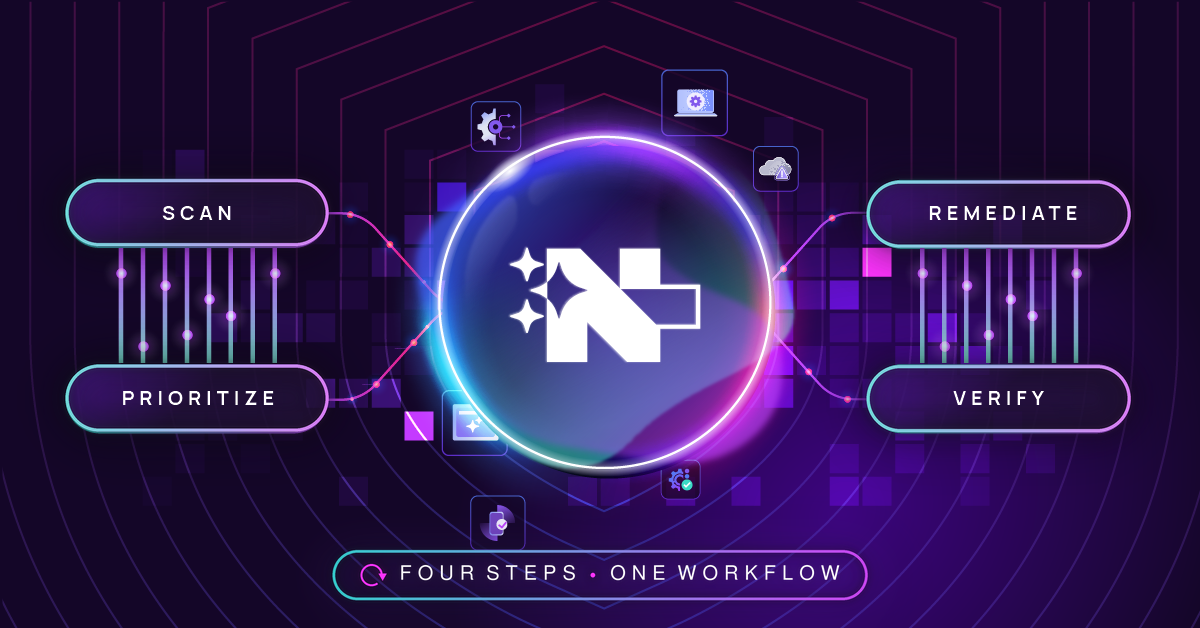
N-central™ and N-sight™ close those seams by connecting all four steps, scan, prioritize, remediate, and verify, natively in one place. The result is exposure measured in minutes, not days, backed by evidence rather than assumptions.
The problem: four steps, four tools, four handoffs
Most vulnerability workflows are stitched together from separate products. A scanner finds the issue. A spreadsheet or a second tool helps rank it. A patch console deploys the fix. And verification, if it happens at all, waits for the next scheduled scan.
Each of those transitions is a manual handoff, and each handoff introduces risk:
- Time lost between steps. Exporting data, importing it elsewhere, and waiting for the next cycle all add hours. Attackers only need one of them.
- Context lost in translation. Prioritization decisions made in one tool don’t always carry into the tool where remediation happens. Detail gets dropped.
- No confirmation the fix worked. Fixed-schedule scanning creates blind spots. You deploy a patch and hope it landed, but you can’t verify until the next scan runs.
Here’s a quick test. If someone asked your team „is this critical CVE remediated across every affected device right now?“, how long would it take to answer with certainty? If the honest answer is „let me check three tools and get back to you,“ your exposure window is wider than it should be.
The core issue is structural. Fragmented tools were built for a slower threat environment, one where disclosure-to-exploitation windows were measured in days. Today that window is measured in hours. A workflow with four seams can’t keep pace with a threat that moves that fast.
What’s needed: one continuous workflow
Closing that gap requires two things working together: a single workflow with no tool switching, and scanning that doesn’t wait for the next scheduled cycle.
A continuous, closed-loop workflow means the four steps connect natively. Detection feeds prioritization. Prioritization feeds remediation. Remediation feeds verification. And verification loops back to confirm the risk is gone, all without exporting data, switching consoles, or handing work between disconnected systems.
On-demand scanning is what makes the loop tight. Instead of waiting hours for the next scheduled scan to confirm a fix, you trigger an immediate re-scan the moment you remediate. You close the loop with evidence, and you close it now.
That’s the difference between a pipeline that leaks time at every seam and a workflow that moves as fast as the threat.
How N-central and N-sight connect all four steps natively
N-central and N-sight deliver the full loop inside the same unified platform your team already uses to manage IT operations. No bolt-on scanner. No separate patch tool. No manual handoffs.
Here’s how each step connects.
Step 1: Scan continuously
Built-in vulnerability scanning runs every 6 hours across 900+ applications on Windows, macOS, and Linux endpoints. There are no extra agents to deploy and no extra tools to license. Scan results include CVE data, CVSS scores, severity levels, CISA KEV active exploitation status, and EPSS probability scores, so the context you need arrives with the finding itself.
New devices get pulled in automatically through continuous device discovery, so nothing on the network slips outside your visibility.
Step 2: Prioritize with real-world context
Detection without prioritization just hands your team a longer to-do list. This is where the N-zo Vulnerability Expert™ takes over.
Instead of sorting a static CVE list by severity alone, the Vulnerability Expert combines CVSS, CISA KEV active exploitation status, EPSS exploit probability, and live device context to surface the exposures that carry the highest real-world risk. Ask it „which vulnerabilities should I address first today?“ or „how many devices are affected by this CVE?“, and you get a ranked, plain-language answer in seconds. No cross-referencing three data sources by hand.
Step 3: Remediate inside the same workflow
Once you know what matters most, you fix it without leaving the vulnerability view. Scanning covers 900+ applications; remediation closes the loop across 340+ third-party applications, all from the same console and agent you use for monitoring and automation. Identify the affected software and deploy the patch without switching tools.
When a patch fails, the N-zo Patch Expert™ turns complex patch signals into plain-language answers, explaining why it failed and whether it’s safe to redeploy, without trawling logs or vendor advisories. Patch policies standardize scheduling, approvals, retries, offline handling, and reboot control across sites and device classes, so completion rates stay high without manual chase work.
Step 4: Verify on demand
This is the step most tools skip. After you remediate, trigger an on-demand re-scan to confirm the patch landed. On-demand scans run independently of the scheduled 6-hour cycle and at higher priority, so you get immediate confirmation instead of waiting for the next scheduled scan to know the risk is actually gone.
The loop closes with evidence, not assumptions. And because patch compliance reports and patch status live in Asset View, you get audit-grade proof as a byproduct of normal operations.
Why the closed loop beats a stitched-together pipeline
It helps to see the two approaches side by side.
A stitched-together pipeline:
- Detection, prioritization, and remediation in separate tools
- Manual exports and handoffs between each step
- Verification delayed until the next scheduled scan
- Exposure windows measured in days
A native closed loop in N-central and N-sight:
- All four steps connected in one continuous workflow
- No tool switching, no manual handoffs
- On-demand re-scan verifies fixes immediately
- Exposure windows measured in minutes
The difference is measured in how long a vulnerability stays open, which is exactly the window attackers are racing to exploit.
The outcome: exposure windows measured in minutes
When scan, prioritize, remediate, and verify live in one workflow, the seams that used to leak time disappear. Your team stops moving data between tools and starts closing risks.
Here’s what that delivers:
- Exposure windows compress from days to minutes. Continuous scanning, guided prioritization, integrated remediation, and on-demand verification happen in one place, at threat speed.
- Closed-loop resolution backed by evidence. On-demand re-scan confirms every fix. You prove the risk is gone rather than assuming it.
- Less tool sprawl, lower cost. Full coverage lives inside the UEM platform you already use, at no additional cost, with no separate consoles to license or learn.
- Senior-level decisions at every skill level. N-zo turns complex risk and patch signals into plain-language guidance, so every technician acts with confidence.
Detection was never the hard part. Closing the loop, quickly and with proof, is what actually reduces risk. N-central and N-sight make that loop a single, continuous workflow, so your team moves at the pace the threat now demands.
Ready to compress your exposure windows from days to minutes? Start a free trial of N-central or N-sight, or talk to our team today to see closed-loop vulnerability and patch management in action.
Next in this series: AI industrialized the attack. Here’s how IT teams industrialize the response.
© N‑able Solutions ULC und N‑able Technologies Ltd. Alle Rechte vorbehalten.
Dieses Dokument dient nur zu Informationszwecken und stellt keine Rechtsberatung dar. N‑able übernimmt weder ausdrücklich noch stillschweigend Gewähr noch Haftung oder Verantwortung für Korrektheit, Vollständigkeit oder Nutzen der in diesem Dokument enthaltenen Informationen.
N-ABLE, N-CENTRAL und andere Marken und Logos von N‑able sind ausschließlich Eigentum von N‑able Solutions ULC und N‑able Technologies Ltd. Sie sind gesetzlich geschützte Marken und möglicherweise beim Patent- und Markenamt der USA und in anderen Ländern registriert oder zur Registrierung angemeldet. Alle anderen hier genannten Marken dienen ausschließlich zu Informationszwecken und sind Marken (oder registrierte Marken) der entsprechenden Unternehmen.