
N-able Shadow AI Visibility is now available to help govern AI usage. (N-central, N-sight, and Adlumin)

By N-able
AI tools are spreading across your environment faster than you can track them. N-able is changing that, giving you complete visibility into every AI tool in use, without adding a single new agent.
The Shadow AI Problem Is Already Inside Your Networks
Employees do not wait for IT approval before reaching for a new tool. They open ChatGPT to draft a report, paste source code into Copilot to debug it faster, or use Gemini to summarize a client call. They are not acting maliciously. They are trying to do their jobs. But they are doing it with AI services that IT has never inventoried, never approved, and cannot see.
This is Shadow AI: the sprawling, unsanctioned use of AI tools across your environment. Unlike the shadow IT of years past (the rogue Dropbox account or personal Gmail), Shadow AI carries a distinct category of risk. These tools do not just store data. They process it, learn from it, and in many cases send it to third-party model providers operating outside your regulatory boundaries.
Employees across knowledge-work environments are already using AI tools regularly, and most IT and security teams have no reliable way to detect it. Browser extensions call AI backends silently. Developer plugins route code to cloud models without triggering traditional software inventory. DNS traffic to AI SaaS platforms is rarely classified in ways that surface AI usage as a distinct risk category.
Why AI Governance Is Now a Security and Compliance Issue
The risks of unmanaged AI tool usage extend well beyond productivity policy. The compliance and security implications are real, immediate, and increasingly on the radar of auditors and cyber insurers.
Consider what is at stake when an employee pastes a customer record into an unsanctioned AI chatbot:
- HIPAA, PCI DSS, and GDPR exposure: Sensitive data processed by an external AI service may violate data residency and handling requirements, even if the employee had no idea.
- Audit failures: Regulators and cyber insurers are now asking for AI inventories. Most organizations cannot produce one because they have never had visibility in the first place.
- Exfiltration risk: AI-assisted data exfiltration, whether intentional or accidental, is difficult to detect when AI traffic looks like ordinary outbound web activity.
- No policy foundation: You cannot enforce an AI acceptable use policy if you do not know which tools are in use, by whom, and how often.
Most organizations are already exposed. They just do not know it yet. The question is whether you get ahead of it now, or wait for an auditor or insurer to force the conversation.
What Real AI Visibility Actually Requires
The first instinct is often to check what existing tools can already see. Can your endpoint management platform detect AI apps? Can your SIEM flag AI traffic? The honest answer: partially, and not in a way that supports governance.
Traditional software inventory catches installed applications, but most AI usage today happens in browsers, through extensions, via API calls from developer tools, and through background processes that never install a visible application. A generic software list that includes ChatGPT alongside every other installed app does not tell you who used it, when, how often, or what data they submitted.
Genuine AI visibility requires four things:
- Endpoint coverage that sees beyond installed software, including browser extensions, IDE plugins, CLIs, and portable executables.
- Network-level detection that catches DNS-based AI SaaS access, where much of actual AI usage lives, invisible to endpoint-only tools.
- Identity attribution so you know not just that AI traffic occurred, but which user, on which machine, through which process.
- AI-aware classification that treats AI tools as a distinct risk category, classified by vendor, model family, and approval status, not just another entry on a software list.
Without all four, you are left with partial data that cannot support policy enforcement, compliance evidence, or security response. That is the gap N-able is closing.
Introducing Shadow AI Visibility in N-able
N-able is announcing Shadow AI Visibility capabilities across N-central, N-sight, and Adlumin, delivering a complete, classified view of every AI tool active in your environment. Together, these capabilities form a unified answer to the Shadow AI problem: see everything, govern what matters, and protect what is at risk.
N-central and N-sight: Endpoint and Network AI Detection Built into the Platform You Already Use
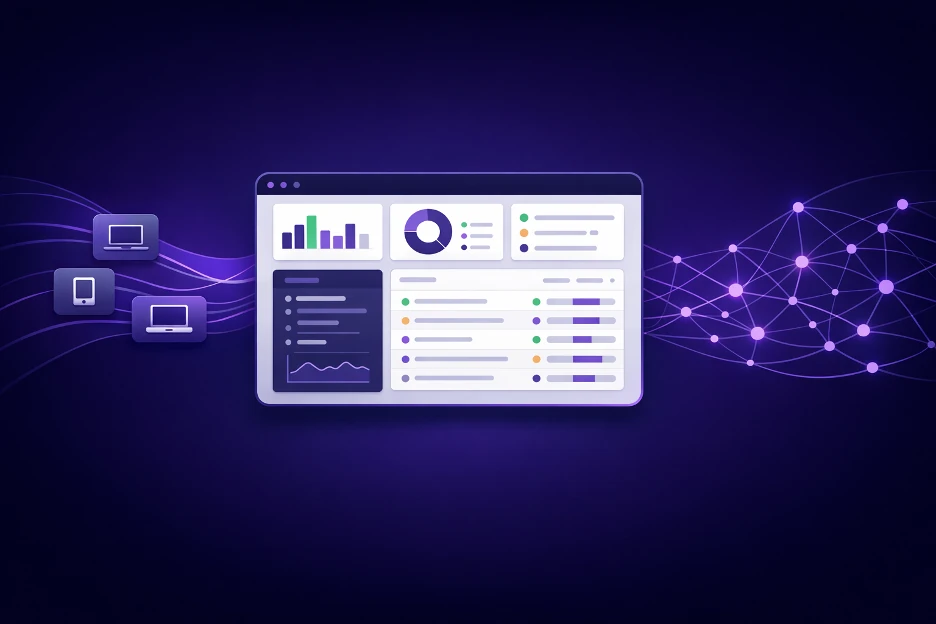
Shadow AI Visibility in N-central and N-sight is a purpose-built capability to detect, classify, and surface every AI tool running across your endpoints and network traffic, including the blind spots that traditional inventory tools miss.
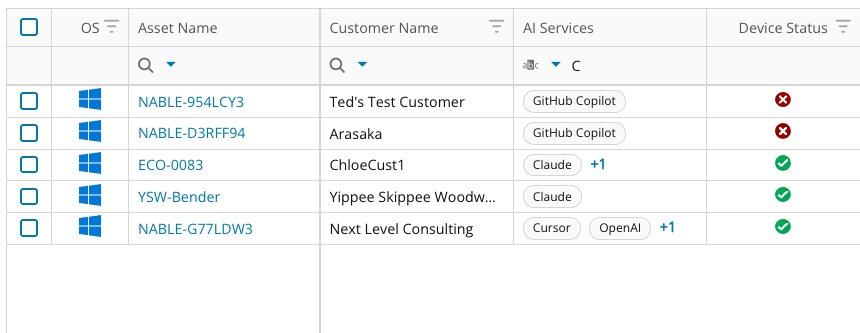
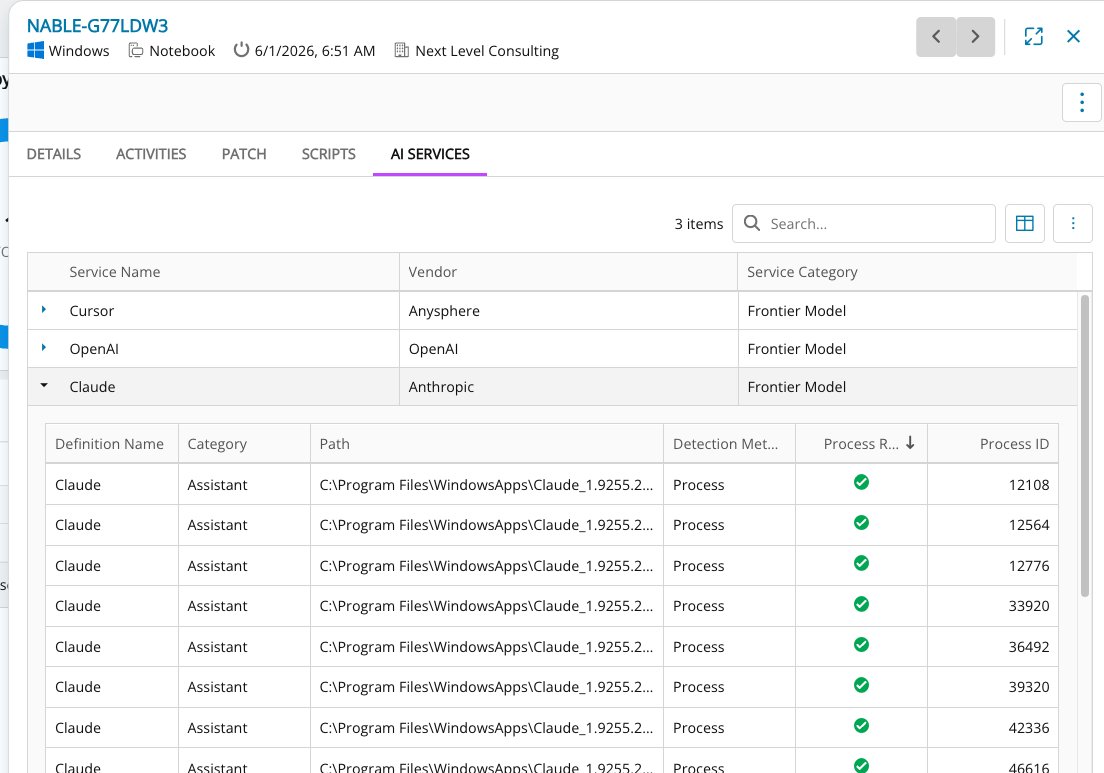
Detection runs through existing technology, with no new agents, no new tools, and no additional infrastructure required. Results surface in a dedicated AI Usage tab, and are also accessible through the GraphQL API, MCP Server, and N-zo AI assistant for natural-language querying.
What it detects:
- Endpoint AI detection: Finds AI apps, IDE plugins, browser extensions, CLIs, and portable executables across your endpoints using delta-only reporting for efficient performance.
- Network-based detection: DNS traffic analysis surfaces browser- and API-level access to AI SaaS platforms, API providers, and model hosting services that endpoint-only tools miss entirely.
- Classification and governance: Auto-classifies tools by category, vendor, and model family. Apply tags for approval status (approved, unapproved, or under review), turning raw data into governable insight.
- Drill-down visibility: A dedicated AI Usage tab with views by tool, user, device, and organization, queryable via UI, GraphQL API, MCP Server, and N-zo.
When an auditor or cyber insurer asks for an AI inventory, you can produce one on demand, with full context, without scrambling for answers.
Adlumin: AI Traffic as a First-Class Detection Surface Inside the SOC
For organizations running Adlumin Security Operations, Shadow AI Visibility goes further, moving AI from a governance blind spot into an actively defended security surface.
Built on Adlumin’s existing DNS Disruption Detection infrastructure, Shadow AI Visibility extends a continuously updated AI domain classification engine across the same telemetry already flowing through the platform. No new agents. No new console. No new procurement cycle.
What makes the Adlumin approach distinct is identity attribution at the process level. Most SIEMs and proxies see AI traffic as undifferentiated outbound web activity. They can tell you traffic went to an AI domain, but not who initiated it, from which machine, or through which application. Adlumin ties every AI interaction to a specific tool, user, machine, and process, making policy enforcement and incident response genuinely actionable.
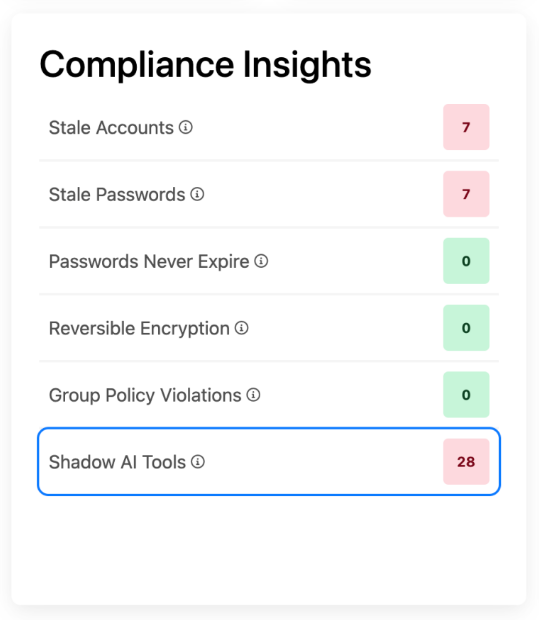
DNS-based detection works regardless of encryption, VPN, or IP rotation, capturing AI usage that proxy- and extension-based tools miss when traffic is obscured.
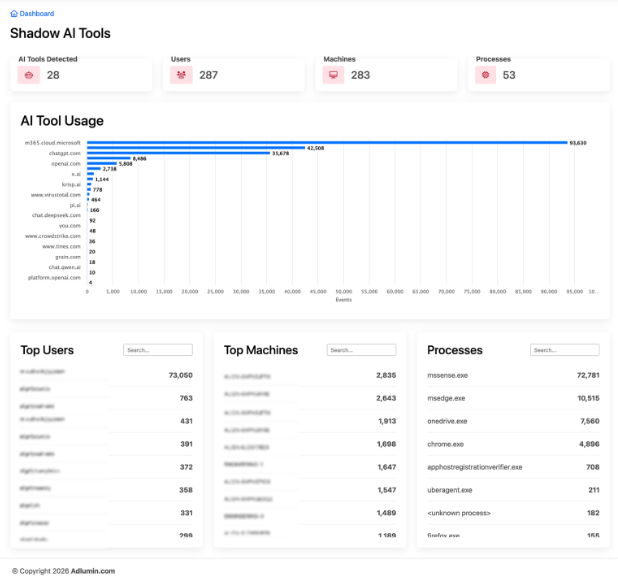
AI traffic is also mapped to MITRE ATT&CK tactics (Exfiltration, Command and Control, Discovery, Defense Evasion), feeding Adlumin’s detection engines, automated response, and 24/7 SOC workflow. When an AI-borne threat fires, it lands in the same SOC queue as ransomware and lateral movement, triaged with the same rigor, not routed to a separate AI security console.
For compliance-focused organizations, Adlumin generates tool-, user-, machine-, and timestamp-stamped records, replacing self-reported AI surveys with audit-grade evidence for SOC 2, HIPAA, ISO 27001, and CMMC.
Sight First. Then Governance.
The principle behind Shadow AI Visibility is straightforward: you cannot govern what you cannot see. Before you can enforce policy, satisfy an auditor, or detect a threat, you need to know what is running in your environment.
The N-able approach gives you that foundation across endpoint and network, across UEM and SOC, without new infrastructure overhead. Whether you manage endpoints through N-central or N-sight, or run security operations through Adlumin, Shadow AI Visibility is built into the platform you are already using.
AI adoption is not slowing down. The window to get ahead of it, before an audit, before insurer pushback, before a data incident, is now.
Shadow AI Visibility is available now in N-central, N-sight, and Adlumin Security Operations. Contact your N-able representative or visit n-able.com for details.
© N‑able Solutions ULC und N‑able Technologies Ltd. Alle Rechte vorbehalten.
Dieses Dokument dient nur zu Informationszwecken und stellt keine Rechtsberatung dar. N‑able übernimmt weder ausdrücklich noch stillschweigend Gewähr noch Haftung oder Verantwortung für Korrektheit, Vollständigkeit oder Nutzen der in diesem Dokument enthaltenen Informationen.
N-ABLE, N-CENTRAL und andere Marken und Logos von N‑able sind ausschließlich Eigentum von N‑able Solutions ULC und N‑able Technologies Ltd. Sie sind gesetzlich geschützte Marken und möglicherweise beim Patent- und Markenamt der USA und in anderen Ländern registriert oder zur Registrierung angemeldet. Alle anderen hier genannten Marken dienen ausschließlich zu Informationszwecken und sind Marken (oder registrierte Marken) der entsprechenden Unternehmen.